Showing posts with label blooms. Show all posts

Friday, October 16, 2015

Monarch Migration - Feeding Them Along the Way

I saw a few small groups of monarchs flitting around the yard today so I'm thinking that this is the beginning of their migration south.   They were really loving the mistflowers today.   But here are some more nectar plants that butterflies seem to go for in my garden.


One of today's monarch visitors feeding on the blue mistflowers.    This mistflower grows low to the ground, dies back in the winter, and blooms in the spring and the fall.  


 Caelsalpenia or Mexican Royal Poinciana with what this uneducated butterfly watcher thinks is some sort of skipper.    Grow it for the blooms and the butterflies are just a bonus.   It has long legume looking seed pods and reseeds easily.   Expect die-back in all but the mildest winters. 


Lantana in all colors is magnetic to butterflies.   The open shape of the flower gives them easy access to the flowers nectar.  I was told that the orange lantana doesn't make nectar, but I've seen butterflies feeding on them so . . .    well, you decide for yourself.   


Lantana comes in tons of different colors.  This pink and yellow combo is a native that you will find growing in brushlines and that we find growing in our tree fields.   Isn't it a beauty!  


Turk's Cap is loved by butterflies and hummingbirds both.    It blooms on new growth so don't be afraid to trim it to the size  you want.   But be aware that it is a vigorous volunteer - but it's easy to pull out when it pops up where you don't want it.   I love large sweeps of Turk's Cap
This delicate little groundcover is called frogfruit.  There is a second variety which has a seraded leaf.    Butterflies love this stuff!   It's a perennial so expect it to die back in the winter.
 
 
This Tropical Milkweed has been the subject of lots of controversy.   With the decline of the monarch population the past few years, some have suggested that tropical milkweed is to blame and that we should only plant the native varieties.  There is a disease that old Tropical Milkweed develops that is toxic to Monarchs.  After a bit more research, it seems that we can keep growing the tropical variety but we are supposed to trim it  back in the fall.  Have no fear;  it will grow back the following spring.  Another thing to consider is that you don't want your migrating butterflies to become confused by available host plants and think they should stay and lay eggs.   Cutting your host plants back in the fall keeps them moving south after a short stop for re-fueling.   


And last, is Porterweed.   It's a vigorous grower with dark purple blooms that must be delicious because mine always has butterflies hanging around. 

Monday, September 14, 2015

Desert Willow

For the past decade, gardeners everywhere are looking for water-wise plants and Desert Willow is one that I want to add to my home landscape.    This Texas native is considered a small tree or large shrub.   We have been growing it at the nursery for the past 4 years and really like how it performs.   We are just now selling our first crop.  They are a little lankier than we would like but we've begun a pruning program that has added fullness to the trees.    

Now, more about Desert Willow.   It's not a willow at all - but a catalpa, if that means anything to you.    This small tree has willow-shaped leaves and blooms from June through October.   The blossoms look like miniature orchids and may be pink, purple, or white.  I've read that there is also a yellow variety but have never seen it.    I'm picturing a flower that's more cream-colored than yellow.
Desert Willow 'Bubba'
There are a couple of patented Desert Willows on the market:  Bubba which blooms a vibrant hot pink and Timeless Beauty which has burgundy and lavender bi-colored flowers.  If the color is important to you, purchase from a reputable nursery or buy when the tree is in bloom.  They begin blooming at a fairly young age - even in a 5 gallon container.


Desert Willow is fast growing and it tends to be a bit leggy.  It may be hard to do, but until your tree is 5 or 6 feet tall, prune it severely.   By that, I mean cut it back by a third.   Do it in late winter.   These trees are deciduous and experience a bit of die back each winter so you'll really feel like you're trimming bare sticks.    Your tree will thank you with a much fuller canopy.    As a bonus, it  flowers on new growth so you'll get more flowers too!   Because it flowers on new growth, you can prune it for the shape you want and not sacrifice any blooms.

Desert Willow is fairly new in nurseries but, they should be available throughout Texas.   Speaking of Texas, Desert Willow grows just about everywhere in Texas except east Texas.   They just get too much rain there - poor people.  It grows in a variety of soil types as long as it is well drained.  

Saturday, June 21, 2014

Stunning Butterfly Host

When I say stunning, I'm not talking about the heliconus butterflies but instead their host plant, Passion Vine or May-pops.    There are many varieties of passion vine and this one is Passiflora incarnata.   It's leaf has three lobes and it's flower is a stunning purple and white beauty.   

Our native passion vine is a host plant to the Gulf Fritillary, Zebra Longwing, Julia, and Variegated Fritillary caterpillars.    I'm trying to increase the varieties of butterfly host plants in our yarden and have been wanting this one.   They begin blooming in June so I have been riding the pasture fence lines in search of one.   I know they're there but no luck yet.   This morning as I sat outside enjoying the early morning, I noticed a "weed" in a lantana.  I have to admit that I'm pretty easy on weeds these days but I don't think this weedy vine was there last weekend.   The leaf was not that of the many weeds common in (or taking over) my flower beds so I walked around for a better look - and it's PASSION VINE!   Must be a gift from God. 

As I said, it is growing up amid a lantana.   If I don't move it or give it something to climb on, it will soon cover everything in this bed.   They are vigorous growers that die back in winter.   I guess I'll enjoy it for a few days and then decide whether to train it up the nearby pillars or transplant it in a better spot.

Happy gardening! 

Friday, December 27, 2013

Attracting Wildlife to Your Garden

This morning we visited my sister-in-law at her new home and soon-to-open B&B.   The M-T Nest is going to be geared to birders and naturalists.   In under an hour, we saw cardinals, green jays, banded kiskadees, a Harris hawk and, of course, Texas' state bird, mockingbirds.   She told tales of the hunting habits of their resident barn owls.    And that was just on our drive up the drive and from inside the house.   It kinda reminded me of Chevy Chase's movie, Animal Farm.  Remember it?   They're trying to sell their New England country home and have enlisted all the townsfolk to help   When the prospective buyers approach the house, someone releases deer to scamper across the law - what a pastoral scene - well, unless you have first-hand experience with deer in your yard

Anyhow, it got me thinking about what our landscapes need to include if we want to attract wildlife to our little piece of paradise.   Some good general guidelines are the requirements to certify a yard as a Certified Backyard Wildlife Habitat.   It's a Texas Parks and Wildlife program.   You can find the application here 
   
Basically, you need food sources, water sources, cover from preditors, and nesting sites.  I had assumed that I'd have to have an almost completely native landscape but the certification only requires that at 50% of the planting a be native.    

Sometimes you will want to get more specific.   We've planted a pecan tree to appeal to the local parrots and leave our sabal and Washingtonia palms untrimmed so the orioles a nice nesting place.  We've left a gnarly old Ashe tree with lots of trunk rot for the Eastern screech owls   We plant fennel, dill, and parsley for the caterpillars to munch on.   And we have lots of red blooming plants to appeal to the hummingbirds.     Frogs find refuge in overturned clay pots and we definitely want some frogs around.  They are voracious mosquito eaters.   

In this new year, I challenge you to plant with a purpose.  Do a little research before you go to your local garden center.   Choose items both for their beauty and for what they will draw into your garden.  Happy gardening! 


Friday, January 13, 2012

Plant Trends

Yucca trucleana or Spanish Daggers
The past year, we've noticed many more calls at our nursery about plants that use very little water - such as this Spanish dagger (Yucca trucleana).

It's native to the Rio Grande Valley and west Texas - flourishing in the dry ranch country.   These are slow growers.    The one pictured was sold at our wholesale nursery, Simmons Oak Farms -  this will make an instant impact, won't it!  I love the sculptural quality of these big yuccas.   

In the spring, yuccas bloom with clusters of beautiful white flowers that some people harvest to eat.   Mockingbirds like to hang out in Spanish daggers - not sure if they are feeding or they just like the cover and protection.    If you want a full Yucca, do not remove the flower pods.    We have noticed that removing the pods before they are nice and dry keeps the branch from splitting into two  heads.  

Be careful that your yucca doesn't get too much water.  To much water will cause the plant to rot.   We had a large Spanish dagger in a planting bed near a huge old ash tree.   That planting area was watered with grey water from our home and everything seemed to be pretty happy there -  until Hurricane Dolly came along.   It tore up the ash so badly that we had to remove it.   That changed everything!  Suddenly there was lots more water and lots more sun.   The Yucca loved the sun - but not the water.   To try to remedy the problem, we've planted a Montezuma bald cypress in the area - maybe in another year or two, the cypress will use enough water that the yucca thrives again. 

Yucca trucleana would be a great addition to your water-wise garden

Wednesday, October 26, 2011

Thinking Spring

I have always struggled when it comes to growing plants from seed - and nasturtiums were the biggest challenge of all!  I just never seem to get a very good stand.   Well, a few years back, my friend, Jean Anne, let me in on the secret  . . .  in the Rio Grande Valley, nasturtiums need to be planted before Halloween.   The next year,  I followed her advice, planting seed in late October and, wolah, great stand and a gorgeous border the following spring.   I know I have some pictures on my home computer and will try to post some this evening because, if I do say so myself, they were stunning!  

So, here is fair warning -  There are just FIVE MORE DAYS to get to the garden center, grab some packets of nasturtium seed, and get them in the ground!   Nasturtium has a large hard seed.  If my soil is nice and pliable, I like to scatter the seed and then just rake them in a bit.   I water deeply one time and then they get what the rest of the bed gets.   Because they will sort of "overwinter", I don't worry about how many sprout the first few weeks.  Some will come up; some will look puny through the winter - but come springtime, they will explode!  I imagine they are growing a beautiful root system through our cooler months . . . .  

I have been kicking myself for not mulching my planting beds this summer - there's tons of bare soil showing - but, now that's turned out to be a good thing.    I have lots of places all ready to sow next springs nasturtiums . . .   If you're looking for a colorful spring border that is easy on your pocketbook, consider nasturtiums.

Wednesday, July 15, 2009

Garden Bloggers Bloom Day - July Edition


Stepping out the front door this morning, it smelled just like heaven! Right by the front door are a couple of potted Maid of Orleans, Jasminum sambac. Although they have been terribley neglected lately, they have already responded to the thorough watering they got last Saturday (4 days!) This is a tender tropical that most of the country grows as a houseplant or an annual. It's a climber (but has no tendrils or suckers). I think it should be given something to weave it's branches around. Some people down here grow it as a large shrub. Pruning probably keeps it bushier than mine are. One thing for sure, Maid of Orleans will bloom and bloom and bloom - and the aroma is heavenly!
This was the first bloom I saw this morning and the only one I'll post for Garden Bloggers Bloom Day. My garden is pretty much like it was in June (only a little more parched and stressed). To see what's blooming all over the world today, visit Carol at May Dreams Gardens.

Saturday, May 9, 2009

The Royal Poinciana Blooms!

In February 2002, we planted this Royal Poinciana, Delonix regia, tree in our Shade Garden. Each spring, when these tropical beauties are sporting vibrant orange-red flowers, ours has let me down - until this year! I think it's already pretty beautiful - but there are LOTS more buds to open. Royal Poinciana, native to Madagascar, is deciduous. It's one of the last trees to leaf-out. A freeze and Christmas Eve snow in 2004 nipped it back some. But this is a fast growing tree - you can expect it to put on about 5 feet a year. Mature height is 30-40 feet. Many trees I notice are wider than they are tall.
The blooms are so high up, it's hard to get a good picture of the flowers - but you can see all the dark round buds on these clusters.

I never realized how large each individual flower is - about 3 inches in length. This tree is grown from seed - and the seed pods are quite impressive too - it's a hard dark seed pod that I would guess measures at least nine inches. If you look close you can see some pods on this picture. Our Royal Poinciana is putting on such a beautiful show that I've forgiven her for making us wait seven long years for our first flower.


Saturday, January 31, 2009

First Signs of Spring

When I see Texas Huisache trees beginning to bloom, I know Spring is right around the corner. Not only is the golden pom-pom pleasing to the eye, the aroma is sweet, sweet, sweet. This small-leafed tree is a member of the mimosa family. It's considered a large shrub or medium tree but my experience leads me to give it lots of room to spread. A word of warning - this is a thorned tree and around my yard the saw bugs LOVE it - thus I feel like I am forever dragging those thorny branches to the brush pile. Huisache is very drought tolerant making it beloved addition to an arid spot in my yard.

Up close, I think the buds are every bit as pretty as the blooms.
Huisache is a Valley native. If you observe a field that has been left fallow for a few years, it seems to be one of the first trees to sprout.
It is an important nesting site for white-wing - guess there's a reason for those thorns. We almost always have a nest in one of our Huisache trees. The day I took these pictures there was a Goldenfinch (American or Lesser, who knows) flitting from blossom to blossom. We've put out two thistle feeders for them - and have not seen a single one feeding there. Guess they're well fed by nature. According to the Native Plant Project, bees are attracted to the pollen of the Huisache tree, not the nectar. I wonder if it's the same for that Goldenfinch.

Sunday, January 18, 2009

Pegging 'Adam'

An added benefit from some recent remodeling has been expanded garden beds! Of course, larger planting areas give us the work of amending the soil and the pressure of "designing" the plantings. Yesterday, as I was doing a bit of gardening housekeeping, I saw new options for the 'Adam' rose (pictured in the back, left of the photo below). Its new canes have stretched out across the newly enlarged bed. New growth at the leaf axils just seemed to say, "peg me". Pegging is a nearly forgotten method of training roses. I doubt I would have thought of it last year - but was lucky enough to hear Jennifer Wilson of Lucy's Garden speak about old garden roses. She grows and sells antique roses in the Rio Grande Valley AND has a pegged rose in her garden. If you have the opportunity to hear her speak, don't pass it up! Her knowledge and enthusiasm are a wonderful combination.

Small climbing roses are suitable for pegging - you need one with canes that grow between 5 and 7 feet. To peg a rose, fasten the canes to the ground by pinning them with a stake or "peg". According the The Guide to Old Roses by The Antique Rose Emporium, we should let our canes harden properly before they are bent down and pegged. My 'Adam' has canes that are growing fairly perpendicular to the ground so I think I may get to bypass this step. The Antique rose Emporium peg their roses twice a year, before the onset of new growth (late January and late August). The canes are usually arranged in a perfect wheel around the center of the plant. Since my rose is planted against the garage wall, I will have a semi-circle.


Adam has double blooms that are salmon and cream colored.

Wednesday, July 30, 2008

Here Kitty, Kitty


How great is this plant that I want to write about after only having it for 10 days! Cat's Whiskers, Orthosiphon stamineus is a tender perennial shrub that grows to about 3' x 3'. The info on its plant tag promised a home run - filtered sun (my new bed is in a filtered sun, pushing shadey spot), attracts hummers and butterflies and a good cut flower. I knew I had to give it a try - and planted a 4" pot in the shade garden 5 days before Hurricane Dolly. I'm afraid ya'll are gonna get pretty be sick of me referencing Hurricane Dolly, but deal with it . . . . Two days after the storm, as we were beginning to gather up the broken tree limbs, this little gal was already blooming! With everything around her looking so crummy, this little Cat's Whiskers brings a smile to my face!

It really does look like Cat's Whiskers! Orthosiphon stamineus can also be found with light blue or a lavender blooms. My only fear is that Dave's Garden says it needs to stay consistently moist. We'll see how adaptable it is . . . .

Tuesday, July 29, 2008

What a Crazy Canna!

I have a bougainvillea that blooms hot pink and salmon on the same branch - and I've seen blooms change colors as they age - but I have never seen anything like this before. My mother-in-law cut this canna last week. You can see that some petals are coral and some are yellow and, still yet, some are yellow with coral spots. But the petal that caught our attention is the one that is 1/2 coral and 1/2 yellow (okay - it's really 2/3s coral and a 1/3 yellow). In the close-up below, you can see a distinct line that separates the two colors. This particular plant has been in her yard for many years and we have never noticed it doing this before. I just love this crazy coloration - it's like the canna can't decide what it wants to be! Any thoughts?


Wednesday, June 11, 2008

Some Kind of Cereus

I'm not positive what kind of Cereus this is - but I'm pretty thrilled that it's blooming! Its blossoms measure 8 or more inches across. My father-in-law dug the parent plant from some brush land along the Arroyo Colorado so I can only assume that it's native to the Rio Grande Valley. In their booklet on Cactus, Groundcovers, and Vines, the Native Plant Project describes Acanthorereus pentagonus as an upright five ribbed cactus. I must admit mine only has three ribs and a definite triangularly shaped stem - but I still think this is it. Commonly called Night Blooming Cereus or Barbed Wire Cactus, it blooms at night from June through August. The pistols and stamens are a buttery yellow.
This bud will probably open in a day or two.

Night Blooming Cereus is a climber. We've planted it in the Rock Garden next to a Mesquite Tree. Since it should only grow to 20 feet, it won't overtake this tree. Until it was recently pruned, its vines had rambled along the the open ground, even putting down roots into some of the porous rocks.


This bloom is from a different night blooming cactus. It is growing intermixed with the larger Cereus. I got this start from my father. Maybe this bed should be called "The Paternal Bed". This Cereus has a flat stem and smaller flowers - but blooms profusely - sometimes I'll count over 20 blossoms on this planting. Too bad they only last one night.

Both of these propogate easily from stem cuttings. You will want to let the cuttings harden a bit before planting. I planted mine directly into the bed.

Monday, June 9, 2008

Bringing the Outdoors In


The thermastat is hitting 100 on a regular basis and it's not fit for man or beast outside during daylight hours - and sometimes throughout the night also. I woke up one morning last week and our overnight low had been 82 degrees. Needless to say, this is the time of year when I lack the desire to venture out and work in the garden. What I do love when it's blistering hot is to bring a little of the outdoors intside - and this is when I'm glad I've given up a little space in the vegetable garden for cut flowers. My all time favorites are zinnias. They are easy to grow - they re-seed - and they are forgiving when I ignore them.

This year I planted Burpee's heirloom Exquisite and some year-old bulk seed. They are both growing well. The only zinnia I have failed at growing were Giant Purity. I had planted them for a party and, of course, I got poor germination followed by disease.

A few native sunflowers have volunteered near the woodpile and no-one's gotten around to chopping them out. They were a bonus the other morning when I was wandering the yard looking for something to cut. The best time to cut flowers and foliage to bring inside is morning. The plants are under less stress then.

Some shrubs can also have great flowers of foliage to include in an arrangement. I love to cut Ixora for both mixed arrangements and as a one item arrangement. The branch is a bit hard so I make some cuts up the branch so it will take up more water.


Just look at how delicate Ixora's flower is - and the color is like a fresh melon.


This is my first year to grow Cosmos. The plants are already shoulder-high - but we'll see how they take the heat! So far, so good.


I always like to include some greenery in my mixed arrangements. A palm frond, like this Lady Palm, Rhapis humilis, makes a nice addition. Coleus is good to cut - and the bonus is that it may well begin rooting before you toss the arrangement into the compost pile. The same goes for Sweet Potato Vine 'Margarite". And I love the lime green of it's leaves. Sometimes I have to search for some that the bugs haven't eaten - something munches on it throughout the summer, but never kills it.


A little bit of variegated dwarf schefflera,
Brassaia, is another good filler.
As an accent, I like to cut a few fronds from the Purple Fountain Grass, Penniselum setaceum 'Rubrum', and one of these days I'm going to use some of the purple grass blades.

I hope you'll give your plants a little haircut and bring the trimmings inside to enjoy!


Tuesday, June 3, 2008

Try and Try Again

This little vignette has turned a hum-drum area into something that gives me an inordinate amount of pleasure. When we planted this Firebush, Hamelia patens, hedge, we left an "alcove" near the garage for something special. We see this small planting bed every time we leave the house and when we drive back in, when we take out the trash and when we feed the dog - I'll bet I pass it at least 5 or 6 times each day. The last few years, I've tried a number of different plants here - a large potted Crown of Thorn, Euphorbia splendens var. milii , potted vines climbing an iron trellis, a white potted Bougainvillea, a trailing Lantana, Lantana montevidensis, draping down the pillar, and even a chimenea - What possessed me to think we would ever pull our lawn chairs onto the driveway for a bonfire? - I found I didn't drag a hose over here to water a potted plant regularly enough basis to keep the plants healthy - and that led to my non-living focal point. One year I built the small raised annual bed with one row of blocks. That didn't make much of a statement, so the next spring, a second row was added - and that was exactly what was needed. This area has been planted for year-round interest. The firebush is just coming into it's own and will bloom until our first cold snap in October or November. In front of the firebush are red Kalanchoes, Kalanchoe blossfeldiana, which will bloom from December through late spring. The small raised bed hold Caladiums right now but soon they will be melting in our heat and will have to be replaced with something more heat tolerant. It's such a small area that it easy to replant and inexpensive too. This is what I love about gardening - the everchanging (and hopefully, improving) of the garden. Some people can put a plan on paper and have it come out lovely - but for me, it's try and try again. The creation of a lovely vignette or a pleasing plant combination is a process. The joy I receive from this little bed comes as much from the process of its creation as from the end result.

Thursday, May 15, 2008

Garden Bloggers Bloom Day in Paradise

Flowering trees are taking center stage this month

. . . and the most stunning of all is the Royal Poinciana, Delonix regia. This deciduous tree is related to Mimosa. It begins blooming with a large flush and can continue for a number of months. The seed pods will be 1 - 2 feet in length.
This Jacaranda, Jacaranda mimosifolia, is growing at the Texas Tourist Bureau in Harlingen. It towers over the building flashing its iridescent purple blooms.

The blue flowers are really coming into their own right now.This was the first time I've planted Salvia 'Victoria Blue'. I'll definitely be looking for it again next spring.


This is Eupatoriam 'Padre Island'. I can't keep all the Eupatoriums straight - this one crawls along the ground and is very salt tolerant.

and finally, blue Porter Weed.


Pato de Chiva

One branch of my Yucca or Spanish Dagger, Yucca treculeana, waited until May to bloom.

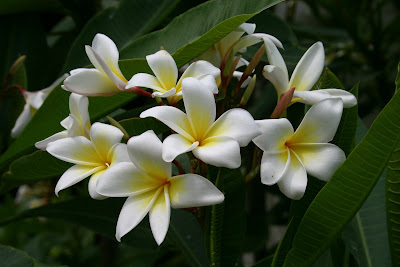
Frangipani, Plumeria obtusa, has got to be the most fragrant plant in my garden.


Bottlebrush, Calistimon rigidus, is blooming for the second time this spring.

Angels Trumpets come out to play when it gets dark.


Louisiana Iris will bloom for months and months and months. Its a great pass-along plant.


Bougainvillea - another tropical that blooms and blooms and blooms!


This is a new Bleeding Heart, Clerodendrum Thomasoniae - I just love the contrast of the white and red.

and the vine pictured below was also labeled as a Bleeding Heart -


Oleander - a real tough cookie - but take care - its leaves are very toxic.


Coral Vine, Antigonon leptopus
An easy way to harvest seed from this vigorous growing vine is to place a sheet on the ground under the vine. In a day or two, gather seeds from the sheet.


Firecracker Bush