Showing posts with label native plants. Show all posts

Saturday, March 7, 2020

Attracting Birds to Your Garden

I spent this morning giving a little talk on Attracting Birds to Your Garden.   The Master Gardeners hosted it and we had a great cross-section of participants - gardeners and Master Gardeners, birders, naturalists and Master Naturalists, and a couple of newcomers to the Rio Grande Valley.   Many who attended know tons more than I do about gardening or birding.   I promised that the hand-outs I shared would be posted here and that has driven me to post for the first time in a couple of years!   (Who knew I had so little to say!)    Instead of just posting the links, I decided to share the basics of  having a bird-friendly garden. 

The birds that introduced me to ornthology only visited my yard by lucky circumstances.    Back then, we lived along the Arroyo Colorado.    The native brush and trees all along the deep, wide banks were mature.    My proximity to such a large natural area was a happy accident but I learned much from it.  

So, lets get to it. 

There are four basic elements that a birds looks for: 
  • Shelter
  • Nesting sites
  • Food
  • Water                                               
SHELTER is cover for birds to watch for danger, hide from preditors,  and get out of the weather.    When you think of creating shelter, think of layers.   You will want to include canopy trees, understory trees, shrubs, and ground cover.   

Multiple layers to attract multiple bird varieties


Here is a printable list of Plant Material for a Bird Friendly Garden


Getting out of the rain

When choosing a NESTING site, breeding birds look for an area large to provide food, nest-building material, and good place to build a nest. 

Here is a list of birds that breed in the RGV along with materials they build their nests with and their preferred foods:   Feeding / Nesting Habits of South Texas Birds

 Many birds build their nests in a fork or crotch of a shrub or tree.   They like the forks to be at about 70 degrees.   A little pruning in early spring to give birds more options, could increase your number of nesting pair.
Hummingbird Nest in Texas Mountain Laurel


A few birds, like kildeer, nighthawks, and commons pauraque,  nest on the ground.   
Common Pauraque on a nest - can you find it?  


Dead limbs or trees are also valued nesting sites.    Birds tend to choose trees to nest in that match their coloring or markings. 

Eastern Screech-Owl in Ash Tree

If you don't have dead limbs or trees, bird boxes can be a great substitute.    Birds are very particular about their nest box and here are some guidelines:  Nesting Box Dimensions. 

There are four basic types of FOOD that a bird will eat:  nectar, seeds, berries, and bugs.   Again, Feeding / Nesting Habits of South Texas Birds will give you specific foods that particular birds eat. 

Do not underestimate the importance of native trees and shrubs in providing food for wild birds.   There are many different definitions of "native" but I think if a plant grows naturally within 100 miles (as the crow flies), it qualifies.    Aim for a minimum of 75% native for a bird-friendly landscape.  

A reliable source of WATER is the 4th element that a bird is looking for.    It will be used in drinking and in bathing.   You can provide it with a birdbath, fountain, or pond.    Birds are attracted to the sound of dripping or gurgling water and it's easy to a dripper to your birdbath.    Elevate your birdbath to keep your birds safe from predators.  

To learn more, you may want to check out some of my favorite books and websites: 

BOOKS
·       Nesting Birds of a Tropical Frontier, The Lower Rio Grande Valley of Texas by Timothy Brush
·       Gardening for the Birds, How to Create a Bird-Friendly Backyard  by George Adams
·       Texas Wildscapes, Gardening for Wildlife by Kelly Conrad Bender
·       Backyard Bird-Lovers Guide by Jan Mahnken 
·       Plants of Deep South Texas, A Field Guide to the Woody and Flowering Species  by Alfred Richardson and Ken King

WEBSITES
·       Native Plant Project  www.NativePlantProject.com
·       A Way To Garden    www.awaytogarden.com  (Also a weekly podcast)
·       Lady Bird Johnson Wildflower Center   www.wildflower.com
·       The Cornell Lab, Bird Academy  www.allaboutbirds.org  


 For optimum bird watching in your own back yard, don't be too tidy.  Leave dead flowers to seed, let "weeds" grow and seed, and leave behind twigs, leaves, etc for nest-building.   Enjoy! 


Friday, December 27, 2013

Attracting Wildlife to Your Garden

This morning we visited my sister-in-law at her new home and soon-to-open B&B.   The M-T Nest is going to be geared to birders and naturalists.   In under an hour, we saw cardinals, green jays, banded kiskadees, a Harris hawk and, of course, Texas' state bird, mockingbirds.   She told tales of the hunting habits of their resident barn owls.    And that was just on our drive up the drive and from inside the house.   It kinda reminded me of Chevy Chase's movie, Animal Farm.  Remember it?   They're trying to sell their New England country home and have enlisted all the townsfolk to help   When the prospective buyers approach the house, someone releases deer to scamper across the law - what a pastoral scene - well, unless you have first-hand experience with deer in your yard

Anyhow, it got me thinking about what our landscapes need to include if we want to attract wildlife to our little piece of paradise.   Some good general guidelines are the requirements to certify a yard as a Certified Backyard Wildlife Habitat.   It's a Texas Parks and Wildlife program.   You can find the application here 
   
Basically, you need food sources, water sources, cover from preditors, and nesting sites.  I had assumed that I'd have to have an almost completely native landscape but the certification only requires that at 50% of the planting a be native.    

Sometimes you will want to get more specific.   We've planted a pecan tree to appeal to the local parrots and leave our sabal and Washingtonia palms untrimmed so the orioles a nice nesting place.  We've left a gnarly old Ashe tree with lots of trunk rot for the Eastern screech owls   We plant fennel, dill, and parsley for the caterpillars to munch on.   And we have lots of red blooming plants to appeal to the hummingbirds.     Frogs find refuge in overturned clay pots and we definitely want some frogs around.  They are voracious mosquito eaters.   

In this new year, I challenge you to plant with a purpose.  Do a little research before you go to your local garden center.   Choose items both for their beauty and for what they will draw into your garden.  Happy gardening! 


Friday, January 13, 2012

Plant Trends

Yucca trucleana or Spanish Daggers
The past year, we've noticed many more calls at our nursery about plants that use very little water - such as this Spanish dagger (Yucca trucleana).

It's native to the Rio Grande Valley and west Texas - flourishing in the dry ranch country.   These are slow growers.    The one pictured was sold at our wholesale nursery, Simmons Oak Farms -  this will make an instant impact, won't it!  I love the sculptural quality of these big yuccas.   

In the spring, yuccas bloom with clusters of beautiful white flowers that some people harvest to eat.   Mockingbirds like to hang out in Spanish daggers - not sure if they are feeding or they just like the cover and protection.    If you want a full Yucca, do not remove the flower pods.    We have noticed that removing the pods before they are nice and dry keeps the branch from splitting into two  heads.  

Be careful that your yucca doesn't get too much water.  To much water will cause the plant to rot.   We had a large Spanish dagger in a planting bed near a huge old ash tree.   That planting area was watered with grey water from our home and everything seemed to be pretty happy there -  until Hurricane Dolly came along.   It tore up the ash so badly that we had to remove it.   That changed everything!  Suddenly there was lots more water and lots more sun.   The Yucca loved the sun - but not the water.   To try to remedy the problem, we've planted a Montezuma bald cypress in the area - maybe in another year or two, the cypress will use enough water that the yucca thrives again. 

Yucca trucleana would be a great addition to your water-wise garden

Sunday, November 20, 2011

Cedar Elm

Cedar Elm (Ulmus crassifolia) is a Texas native that is greatly underutilized as a landscape tree.   It comes to mind this time of year because it is just about the only tree in deep south Texas with any realiable Autumn color.   Its small, dark green leaves turn yellow and orange with cooler temperatures.   According to the Texas Forest Service, it is tollerant to salty soil, sea spray, drought, and poorly drained sites.   It grows naturally in alkaline soil and is a tidy little tree

Tuesday, October 27, 2009

Saturday, March 14, 2009

Texas Mountain Laurel (Mescal Bean)

During much of the year, Texas Mountain Laurel, Sophora secundaflora, is easily overlooked. But in March, this small accent tree is a show stopper. That's when you will find them covered with huge clusters of purple flowers.
Native to Central Texas, this member of the Pea family tends to be a multi trunked, somewhat slow growing plant. Although I've seen some larger, most Texas Mountain Laurels will grow to about 12 -15 feet. It has dark green, glossy leaves.
Native to the alkaline hills of Central Texas, this is a drought tolerant plant. It will tolerate the heavy clays of the lower Rio Grande Valley but make sure that you plant it in an area that drains well. It doesn't like wet feet. It's root structure is very sparce - with very few fibrous roots. (guess that's why it grows well in the Hill Country) This makes transplanting a little bit difficult. If you break the root ball while planting, you may lose your tree.


Oh, but what a reward this tree gives in March! The wisteria-like blooms smell like grape soda and attract bees and butterflies alike!
But beware. Most parts of this plant are poisonous - especially the claret red seeds in the seed pods. Another common name for Sophora secundaflora is Mescal Bean. Indians used the seeds as hallucinogenics - and I have read of deaths from this practice.


You can see why this tree is often overlooked when not in bloom. This one looks a little starved for nitrogen - the leaves tend to be much darker green.
Mountain Laurel is deer resistant - but the webworms love the one in my yard. My hubbie is pretty good about checking it a few times a week and squishing all the little worms that are munching on it. We have never needed to apply any chemical, but if squishing the worms is not your cup of tea, a BT product to take care of the worms.


This tree is just beginning to bloom. Mountain Laurel will produce its bloom stem many months before it's time to bloom. Some people mistakenly think they are from last years blossoms and remove them - then they wonder why their tree didn't flower!


Saturday, January 31, 2009

First Signs of Spring

When I see Texas Huisache trees beginning to bloom, I know Spring is right around the corner. Not only is the golden pom-pom pleasing to the eye, the aroma is sweet, sweet, sweet. This small-leafed tree is a member of the mimosa family. It's considered a large shrub or medium tree but my experience leads me to give it lots of room to spread. A word of warning - this is a thorned tree and around my yard the saw bugs LOVE it - thus I feel like I am forever dragging those thorny branches to the brush pile. Huisache is very drought tolerant making it beloved addition to an arid spot in my yard.

Up close, I think the buds are every bit as pretty as the blooms.
Huisache is a Valley native. If you observe a field that has been left fallow for a few years, it seems to be one of the first trees to sprout.
It is an important nesting site for white-wing - guess there's a reason for those thorns. We almost always have a nest in one of our Huisache trees. The day I took these pictures there was a Goldenfinch (American or Lesser, who knows) flitting from blossom to blossom. We've put out two thistle feeders for them - and have not seen a single one feeding there. Guess they're well fed by nature. According to the Native Plant Project, bees are attracted to the pollen of the Huisache tree, not the nectar. I wonder if it's the same for that Goldenfinch.

Friday, October 17, 2008

Butterflies & Blooms

Took a little stroll in Ramsey Park the other day and if I didnt' know better, I would have thought it was Spring! Everything was in bloom - and the butterflies were this - Sulfers, Queens and many like the picture below. I think this butterfly is a Bordered Patch, Chlosyne lacinia. According to the National Audubon Society Field Guide to North American Butterflies, it is the most widespread and abundant "checkerspot" of the Americas. Its range is SE California east to Texas and south to Argentina. Habitat is subtropical thorn forests, desert hills, weedy edges of agricultural fields, river bottomlands, pinyon pine and oak woodlands, parks and gardens - in other words, just about everywhere there are plants!

I can usually find any Valley native plant I'm looking for in Trees, Shrubs, & Cacti of South Texas, by Everitt & Drawe - the not this pretty white flower. I'm a huge fan of white flowers - they don't photgraph worth a darn, but they sure are beautiful at dawn and dusk. The RGV Master Naturalists always have a booth at the RGV Birding Festival. They are certain to know this plant!
And of course, there was lots of Turks's Cap. The Turk's Cap, Malvaviscus arboreus var. Drummondii, inspired me so that we went straight to Grimsell's to pick up a few pots for my garden. I can't decide whether I was blown away by the number of blooms or the number of butterflies!

Monday, June 16, 2008

Garden Bloggers Bloom Day - June Edition

Welcome to June's Garden Blogger's Bloom Day in Deep South Texas. This month's theme should be "Only the Strong Survive!" I realize that all of Texas and most of the country are suffering through this month's unseasonably high temperatures. Our plants are no different. As I uploaded this morning's photographs, I thought the blooms are looking a bit tired - this heat sure puts them under added stress too! We'll begin with the heat lovin' Bougainvillea in salmon above and red below.

Here's another heat lover, Mexican Bird of Paradise, Caesalpinia pulcherrima
And I really should take a few minutes to find out the name of this vine. I know some of you must know it! It's a self seeder that comes back every summer and decorates the Firebush with its star-shaped flowers. My sister-in-law, Martha and Chris saw it growing in Roundtop, Texas and plucked a few seeds - thus, we just call it the Roundtop Vine.
Louisiana Iris will bloom until the first cool snap next fall. One thing I've learned is to separate it every 3 or 4 years. Otherwise, it keeps growing outwardly and you will end up with more of a circle than a round plant.
Bleeding Heart Vine Clerodendrum thomasoniae is still blooming - but it sure doesn't look as vibrant as it did a month ago.
Zinnias are coming into their own in all shades of purple, pink and red. I don't know what happened to the orange and yellow seed!

And who doesn't love the orange clusters on Flame of the Woods, Ixora coccinea. There is also a yellow gold variety that I'm looking for a spot for. Lately I've noticed some lovely plantings that have mixed the orange and yellow together.
The large flowering Crown of Thorns, Euphorbia splendens var. milii is becoming a bit speckled. It and the miniature variety below are both grown in pots around here.


This small bed of Mealycup Sage, Salvia farinacea 'Victoria Blue' has grown and bloomed so well, I added a few more plants to it. I trimmed back the Scarlet Sages, Salvia coccinea 'Lady in Red' and 'Coral Nymph' last week - we'll see what they're doing in July.

Pentas lanceolata just keep blooming and blooming and blooming. They are paired with the blue Mealycup Sage under the flag pole for a bit of a patriotic bed.
I can't bring myself to pull out the volunteer Periwinkles, Vinca minor. Both the purple and white are staking claim among the Ixora. The Frangipani is looking a bit tattered after some high winds last week.
This Daylily, Hemerocallis sp. 'Splendora Sunrise was a Mother's Day gift last year. We had to move them for a construction project - but they don't seem to mind.
Trailing white lantana, Lantana montevidensis is growing in a pot in a transition bed. I love the how the white shines in the moonlight.
Thyrallis is attracting lots of butterflies and bees. Its bright yellow flowers show up from a distance.
and Butterfly Weed, Asclepias tuberosa has sprouted all over the "Native Beds". She shares the space below native trees with the Frogfruit, pictured below.

This Porterweed has a great blue color. I need to find a little spot for some of the red variety.

Padre Island Mistflower is also crawling around in the "Native Bed".
The yellow pistols against the red Jatropha is a pretty combination.
All the Coleus is trying to bloom - but I'm pinching out the bloom stems as soon as I see them. Of course, I think its leaf is a pretty as most blossoms.
Variegated Shell Ginger is putting on quite a show. Or maybe it's just that I've finally noticed its details after years of ignoring it. Check out the beautiful yellow shell that peeps out of the white pod.
There are some re-bloom patches in the Bottlebrush hedge.
Pam from Digging has her gecko - but I have my own garden mascot. This large one-legged frog. Sometimes I can catch her early in the morning before the sun has warmed things up - or my dog, Red, has had a chance to chase her off. She is amazingly fast.
To see what's blooming in gardens around the world, visit Carol at May Dreams Gardens.


Thursday, May 15, 2008

Garden Bloggers Bloom Day in Paradise

Flowering trees are taking center stage this month

. . . and the most stunning of all is the Royal Poinciana, Delonix regia. This deciduous tree is related to Mimosa. It begins blooming with a large flush and can continue for a number of months. The seed pods will be 1 - 2 feet in length.
This Jacaranda, Jacaranda mimosifolia, is growing at the Texas Tourist Bureau in Harlingen. It towers over the building flashing its iridescent purple blooms.

The blue flowers are really coming into their own right now.This was the first time I've planted Salvia 'Victoria Blue'. I'll definitely be looking for it again next spring.


This is Eupatoriam 'Padre Island'. I can't keep all the Eupatoriums straight - this one crawls along the ground and is very salt tolerant.

and finally, blue Porter Weed.


Pato de Chiva

One branch of my Yucca or Spanish Dagger, Yucca treculeana, waited until May to bloom.

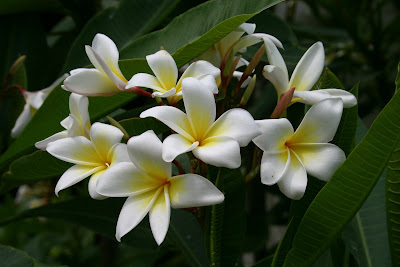
Frangipani, Plumeria obtusa, has got to be the most fragrant plant in my garden.


Bottlebrush, Calistimon rigidus, is blooming for the second time this spring.

Angels Trumpets come out to play when it gets dark.


Louisiana Iris will bloom for months and months and months. Its a great pass-along plant.


Bougainvillea - another tropical that blooms and blooms and blooms!


This is a new Bleeding Heart, Clerodendrum Thomasoniae - I just love the contrast of the white and red.

and the vine pictured below was also labeled as a Bleeding Heart -


Oleander - a real tough cookie - but take care - its leaves are very toxic.


Coral Vine, Antigonon leptopus
An easy way to harvest seed from this vigorous growing vine is to place a sheet on the ground under the vine. In a day or two, gather seeds from the sheet.


Firecracker Bush