 This little vignette has turned a hum-drum area into something that gives me an inordinate amount of pleasure. When we planted this Firebush, Hamelia patens, hedge, we left an "alcove" near the garage for something special. We see this small planting bed every time we leave the house and when we drive back in, when we take out the trash and when we feed the dog - I'll bet I pass it at least 5 or 6 times each day. The last few years, I've tried a number of different plants here - a large potted Crown of Thorn, Euphorbia splendens var. milii , potted vines climbing an iron trellis, a white potted Bougainvillea, a trailing Lantana, Lantana montevidensis, draping down the pillar, and even a chimenea - What possessed me to think we would ever pull our lawn chairs onto the driveway for a bonfire? - I found I didn't drag a hose over here to water a potted plant regularly enough basis to keep the plants healthy - and that led to my non-living focal point. One year I built the small raised annual bed with one row of blocks. That didn't make much of a statement, so the next spring, a second row was added - and that was exactly what was needed. This area has been planted for year-round interest. The firebush is just coming into it's own and will bloom until our first cold snap in October or November. In front of the firebush are red Kalanchoes, Kalanchoe blossfeldiana, which will bloom from December through late spring. The small raised bed hold Caladiums right now but soon they will be melting in our heat and will have to be replaced with something more heat tolerant. It's such a small area that it easy to replant and inexpensive too. This is what I love about gardening - the everchanging (and hopefully, improving) of the garden. Some people can put a plan on paper and have it come out lovely - but for me, it's try and try again. The creation of a lovely vignette or a pleasing plant combination is a process. The joy I receive from this little bed comes as much from the process of its creation as from the end result.
Showing posts with label shrubs. Show all posts
Showing posts with label shrubs. Show all posts
Tuesday, June 3, 2008
Try and Try Again
This little vignette has turned a hum-drum area into something that gives me an inordinate amount of pleasure. When we planted this Firebush, Hamelia patens, hedge, we left an "alcove" near the garage for something special. We see this small planting bed every time we leave the house and when we drive back in, when we take out the trash and when we feed the dog - I'll bet I pass it at least 5 or 6 times each day. The last few years, I've tried a number of different plants here - a large potted Crown of Thorn, Euphorbia splendens var. milii , potted vines climbing an iron trellis, a white potted Bougainvillea, a trailing Lantana, Lantana montevidensis, draping down the pillar, and even a chimenea - What possessed me to think we would ever pull our lawn chairs onto the driveway for a bonfire? - I found I didn't drag a hose over here to water a potted plant regularly enough basis to keep the plants healthy - and that led to my non-living focal point. One year I built the small raised annual bed with one row of blocks. That didn't make much of a statement, so the next spring, a second row was added - and that was exactly what was needed. This area has been planted for year-round interest. The firebush is just coming into it's own and will bloom until our first cold snap in October or November. In front of the firebush are red Kalanchoes, Kalanchoe blossfeldiana, which will bloom from December through late spring. The small raised bed hold Caladiums right now but soon they will be melting in our heat and will have to be replaced with something more heat tolerant. It's such a small area that it easy to replant and inexpensive too. This is what I love about gardening - the everchanging (and hopefully, improving) of the garden. Some people can put a plan on paper and have it come out lovely - but for me, it's try and try again. The creation of a lovely vignette or a pleasing plant combination is a process. The joy I receive from this little bed comes as much from the process of its creation as from the end result.


Thursday, May 15, 2008
Garden Bloggers Bloom Day in Paradise
Flowering trees are taking center stage this month
 . . . and the most stunning of all is the Royal Poinciana, Delonix regia. This deciduous tree is related to Mimosa. It begins blooming with a large flush and can continue for a number of months. The seed pods will be 1 - 2 feet in length.
 This Jacaranda, Jacaranda mimosifolia, is growing at the Texas Tourist Bureau in Harlingen. It towers over the building flashing its iridescent purple blooms.
 . . . and the most stunning of all is the Royal Poinciana, Delonix regia. This deciduous tree is related to Mimosa. It begins blooming with a large flush and can continue for a number of months. The seed pods will be 1 - 2 feet in length.
 This Jacaranda, Jacaranda mimosifolia, is growing at the Texas Tourist Bureau in Harlingen. It towers over the building flashing its iridescent purple blooms.
The blue flowers are really coming into their own right now. This was the first time I've planted Salvia 'Victoria Blue'. I'll definitely be looking for it again next spring.
 This is Eupatoriam 'Padre Island'. I can't keep all the Eupatoriums straight - this one crawls along the ground and is very salt tolerant.
 and finally, blue Porter Weed.
 Pato de Chiva

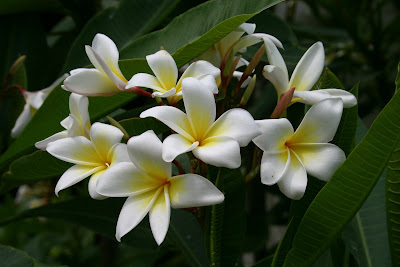 Frangipani, Plumeria obtusa, has got to be the most fragrant plant in my garden.
 Bottlebrush, Calistimon rigidus, is blooming for the second time this spring.
 Angels Trumpets come out to play when it gets dark.
 Louisiana Iris will bloom for months and months and months. Its a great pass-along plant.
 Bougainvillea - another tropical that blooms and blooms and blooms!

This is a new Bleeding Heart, Clerodendrum Thomasoniae - I just love the contrast of the white and red.
 This was the first time I've planted Salvia 'Victoria Blue'. I'll definitely be looking for it again next spring.
 This is Eupatoriam 'Padre Island'. I can't keep all the Eupatoriums straight - this one crawls along the ground and is very salt tolerant.
 and finally, blue Porter Weed.
 Pato de Chiva
One branch of my Yucca or Spanish Dagger, Yucca treculeana, waited until May to bloom.
Frangipani, Plumeria obtusa, has got to be the most fragrant plant in my garden. Bottlebrush, Calistimon rigidus, is blooming for the second time this spring. Angels Trumpets come out to play when it gets dark.
 Louisiana Iris will bloom for months and months and months. Its a great pass-along plant.
 Bougainvillea - another tropical that blooms and blooms and blooms!
This is a new Bleeding Heart, Clerodendrum Thomasoniae - I just love the contrast of the white and red.
and the vine pictured below was also labeled as a Bleeding Heart - 

Oleander - a real tough cookie - but take care - its leaves are very toxic.
 Coral Vine, Antigonon leptopus
An easy way to harvest seed from this vigorous growing vine is to place a sheet on the ground under the vine. In a day or two, gather seeds from the sheet.
 Firecracker Bush


Oleander - a real tough cookie - but take care - its leaves are very toxic.
Coral Vine, Antigonon leptopusAn easy way to harvest seed from this vigorous growing vine is to place a sheet on the ground under the vine. In a day or two, gather seeds from the sheet.
 Firecracker Bush
Saturday, April 5, 2008
An Aphid Invasion!

The aphids are coming!
The aphids are coming!
I'm afraid that this warning is a bit late for this stand of Hamelia patens or Firebush. About a half of the individual plants are already affected to one degree or another. One is already completely defoliated and the others are all a flitter with insect activity. 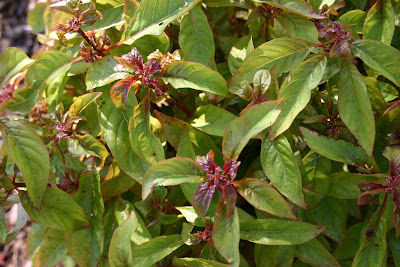 Notice the shine from the honeydew on this plant - Add the cupping of the new growth and you can be pretty certain you have a healthy community of aphids.
 Notice the shine from the honeydew on this plant - Add the cupping of the new growth and you can be pretty certain you have a healthy community of aphids.
On a side note, I want to share with you the first aphid treatment I ever read about (and this was my practice for years!). Treatment consisted of a Q-tip and rubbing alcohol. It works well, but it would take hours of time and gallons of rubbing alcohol for this infestation. Of course, this treatment was described in a book about houseplants. . . .
 Pictured above is one of the Hamelia paten (Firebush) that has not been affected yet. I was a little unconvinced when my husband suggested that we just leave this planting alone and let nature take its course. He even opined that this could be good as it would attract lots of beneficials to our yard. Although he has farmed for over 30 years, I wasn't convinced and did a bit of research on my own. In his article, Aphids in Texas Landscapes, Bastiaan M. Drees from Texas A & M concurs.
 There are many different kinds of aphids and most entomologists will tell you that identifying your pest exactly is not important. Notice the yellow aphids on this firebush. If you look closely you can see some white skins. Aphids molt about 4 times on their journey from larvae to adult stage.

 Check out the spreading wings on this ladybug. She must be ready to fly off to a new - and more bountiful - plant. A ladybug egg hatches somewhere between 4 and 10 days. But the "baby" is not exactly a miniature of the adult.
 The above bug is a ladybug larvae, often refered to as an alligator. The close-up picture below depicts just how descriptive the name "alligator" is.
 The presence of alligators is a good sign that we are well on the way to controlling our aphid infestation. It means that we have multiple generations of beneficials in our garden.
  This alligator is so much duller than the others. I wonder if it is molting. It has the same markings as the vibrantly colored one above. The Ladybug Lady shares larvae and adult pictures that show various ladybug species.
 My husband pointed out this white fuzzy beneficial. He couldn't give me a name for it but assured me this is a good guy! Looking at this plant might make you think you need to take some action. But look a bit closer. Most of the markings are molted skins. To treat at this point would kill your garden beneficials.

 Pictured above is one of the Hamelia paten (Firebush) that has not been affected yet. I was a little unconvinced when my husband suggested that we just leave this planting alone and let nature take its course. He even opined that this could be good as it would attract lots of beneficials to our yard. Although he has farmed for over 30 years, I wasn't convinced and did a bit of research on my own. In his article, Aphids in Texas Landscapes, Bastiaan M. Drees from Texas A & M concurs.
 There are many different kinds of aphids and most entomologists will tell you that identifying your pest exactly is not important. Notice the yellow aphids on this firebush. If you look closely you can see some white skins. Aphids molt about 4 times on their journey from larvae to adult stage.
To further prove his point, my hubby took me outside to check for beneficials. This orange ladybug was the first we saw. She was moving so fast that I had a hard time getting a good picture. I guess when you have this number of aphids to devour you have no time to waste!
There are about 500 different Ladybug species in the United States and almost 5,000 worldwide! They come in a variety of colors (Reds, yellows, orange, gray, black, brown and even pink) with and without dots.
Check out the spreading wings on this ladybug. She must be ready to fly off to a new - and more bountiful - plant. A ladybug egg hatches somewhere between 4 and 10 days. But the "baby" is not exactly a miniature of the adult. The above bug is a ladybug larvae, often refered to as an alligator. The close-up picture below depicts just how descriptive the name "alligator" is.
 The presence of alligators is a good sign that we are well on the way to controlling our aphid infestation. It means that we have multiple generations of beneficials in our garden.
  This alligator is so much duller than the others. I wonder if it is molting. It has the same markings as the vibrantly colored one above. The Ladybug Lady shares larvae and adult pictures that show various ladybug species.
 My husband pointed out this white fuzzy beneficial. He couldn't give me a name for it but assured me this is a good guy! Looking at this plant might make you think you need to take some action. But look a bit closer. Most of the markings are molted skins. To treat at this point would kill your garden beneficials.
Could this bug have been inspiration for the set designer of The Matrix? Up close, he does look pretty vicious!
Happy gardening from my little biology lab to yours!
Tuesday, April 1, 2008
A Tropical Treasure
 A South American native, Bougainvillea puts on quite a show for months on end. I have always loved the many colors of this particular specimen. The dark salmon bracts fade to pale pink as they age. After much looking, I can't decide which variety I think it is . My best two guesses are Bougainvillea Buttiana 'Temple Fire' or Bougainvillea 'Rosenka'. If I had to choose the most descriptive name, it would definitely be 'Temple Fire'.
 When I purchased this particular plant it was viney and trained to a small trellis. In the past five years, I have come to see that it's natural form is actually bushy and smallish (small for a bougainvillea, that is).
 Bougainvillea is propogated by stem cuttings taken in the winter or spring. It blooms on new growth so feel free to trim away after a flush of blooms. Hardy to 25 degrees, bougainvillea is a great choice in Deep South Texas.
 Sunday, March 30, 2008
Check Out This Gruss an Aachen!
 This Gruss an Aachen floribunda rose has responded wonderfully to its February pruning and fertilizer. Planted at the end of 2003, it has been given very little care. Outside of a weekly watering and yearly (or sometimes twice a year) application of a time released fertilzer, this rose is on its own! The only disease treatment consists of me plucking off the effected leaves.
 I sure wish this picture captured the bloom colors better. Gruss an Aachen has more coral than came through in the photos. There is just a huge range of colors in the buds and blooms. As the buds open, they fade to a pink so pale it's almost white.
 This three to four foot shrub works well either in containers or as part of a perenial bed. The 3" double blooms have a sweet honey smell. When I bring myself to cut some for an vase, I make sure they are placed where I can catch the wonderful aroma.
Gruss an Aachen is believed to be the rose that began the Floribunda class. Floribundas were developed by crossing the large flowers of Hybrid Teas with the carefree Polyanthas.
For some great ideas on incorporating Antique Roses into your landscape, check out Mike Shoup's Antique Rose Emporium. They have display gardens at both their locations. The original location in Independence, Texas has more of an Early Texas/Cottage Garden look while the San Antonio location takes you to a Spanish Hacienda. If you can't get there in person, you can always take a cyberspace tour!
Sunday, March 23, 2008
Happy Easter from My Garden to Yours!
 I wandered around the garden this morning to find the miniature Poinciana blooming! Also know as Mexican Bird of Paradise, Caesalpinia pulcherrima, is a tender but large shrub that will bloom from now until October. It grows to about 10 feet tall in my garden. This plant was given to me by friends, Jim and Sue, and does beautiful in poor soil and hot weather! (Of which, I have an abundance!) It grows easily from seed and may be a little bit aggresive for some people. I find that the sprouts are easily removed and that it is worth the extra "weeding".
 Wednesday, March 19, 2008

Monday, March 17, 2008
Garden Bloggers Bloom Day
This Garden Blogger Bloom Day, I am mainly sharing the things that weren't blooming last month!
 Bottlebrush, Callistemon rigidus, is beginning its bloom period. The one gallon pots we planted in 2004 are now easily 7 feet tall, giving us a nice, dense privacy hedge. Its clear to see where the name, bottlebrush, comes from!
 Anacua, Ehretia anacua, is turning white with blossoms! It won't be long before the bees and butterflies have found this tree. This deciduous native tree is just getting a fresh crop of leaves. Their light green color will darken with age. Anacua gets one of its common names, the "Sandpaper Tree", from the sandpaper-like texture of its leaves.
  Hibiscus, Rosa sinensis, belongs to the mallow family. Other relatives are cotton, okra, and hollyhocks. There are hundreds of colors and color combinations along with a vast variety in plant and bloom size. In the early 80s when we received two years of hard freezes in a row, I quit growing this tropical. It is sensitive to a frost, but it takes a pretty hard freeze to kill an established hibiscus in the ground. A light freeze just give it a bit of a pruning. It's easy to propogate from stem cutting. For lmore information, you may want to check out the American Hibiscus Society's website.
 Our little Texas Mountain Laurel, Sophora secundiflora, has finally begun to bloom. Everything I've read says that it will grow in part shade (which is where we planted ours). I wonder if this location is affecting its blooming. It doesn't have very long bloom stems, but the aroma is still amazing!
 I don't know why I love the combination of blooms and buds - possibley it's the feeling of hope and anticipation that a flower bud inspires in me! This Thyrallis, Galphimia glauca, has that wonderful combination of blooms and buds that I love so much.
 The Nasturtiums, Tropaeolum majus, have grown a great deal the past month. Aren't they pretty?

 Bottlebrush, Callistemon rigidus, is beginning its bloom period. The one gallon pots we planted in 2004 are now easily 7 feet tall, giving us a nice, dense privacy hedge. Its clear to see where the name, bottlebrush, comes from!
 Anacua, Ehretia anacua, is turning white with blossoms! It won't be long before the bees and butterflies have found this tree. This deciduous native tree is just getting a fresh crop of leaves. Their light green color will darken with age. Anacua gets one of its common names, the "Sandpaper Tree", from the sandpaper-like texture of its leaves.
  Hibiscus, Rosa sinensis, belongs to the mallow family. Other relatives are cotton, okra, and hollyhocks. There are hundreds of colors and color combinations along with a vast variety in plant and bloom size. In the early 80s when we received two years of hard freezes in a row, I quit growing this tropical. It is sensitive to a frost, but it takes a pretty hard freeze to kill an established hibiscus in the ground. A light freeze just give it a bit of a pruning. It's easy to propogate from stem cutting. For lmore information, you may want to check out the American Hibiscus Society's website.
 Our little Texas Mountain Laurel, Sophora secundiflora, has finally begun to bloom. Everything I've read says that it will grow in part shade (which is where we planted ours). I wonder if this location is affecting its blooming. It doesn't have very long bloom stems, but the aroma is still amazing!
 I don't know why I love the combination of blooms and buds - possibley it's the feeling of hope and anticipation that a flower bud inspires in me! This Thyrallis, Galphimia glauca, has that wonderful combination of blooms and buds that I love so much.
 The Nasturtiums, Tropaeolum majus, have grown a great deal the past month. Aren't they pretty?
Friday, February 29, 2008
Field Trip!
 February 29th is a free day in my book - so we took a break and headed off to Harlingen's World Birding Center. The park had tons of visitors today so ours was not an original idea. . . .
I had never seen Guayacan, Guaiacum agustifolium, blooming until today - Wow! What a beauty! I don't have any in my yard - but will be adding one or two this spring! This is an understory tree as it only grows to 8 or 10 feet. This one was nearly as wide as it was tall. The bark can be made into soap, so this plant is also called soapbush. This Valley native would look great in any landscape!

On the north side of the park, there are large plantings of prickly pear cactus. Lot of buds beginning to pop out. I'll have to check back in a week or two and see if they're blooming!

This is a piece of citrus "staked" on this tree. I know that orioles and woodpeckers both love fruit. Volunteers had placed citrus halves all over the park - especially near the photo blinds.

There are many ponds all over the park - but this American Coot was the only water bird we saw - it must have been naptime.

I thought this grass was especially pretty. I don't know its name and am too lazy tonight to look it up! Feel free to educate me!


This little sweetie is the other half of my "we". I must admit that playing on the "dinosaur eggs" was her favorite part of our excursion!
Special thanks go out to the Arroyo Colorado Audubon Society and the Cameron County Master Naturalists for all their work in this park.
Subscribe to:
Posts (Atom)