Showing posts with label vines. Show all posts

Saturday, June 21, 2014

Stunning Butterfly Host

When I say stunning, I'm not talking about the heliconus butterflies but instead their host plant, Passion Vine or May-pops.    There are many varieties of passion vine and this one is Passiflora incarnata.   It's leaf has three lobes and it's flower is a stunning purple and white beauty.   

Our native passion vine is a host plant to the Gulf Fritillary, Zebra Longwing, Julia, and Variegated Fritillary caterpillars.    I'm trying to increase the varieties of butterfly host plants in our yarden and have been wanting this one.   They begin blooming in June so I have been riding the pasture fence lines in search of one.   I know they're there but no luck yet.   This morning as I sat outside enjoying the early morning, I noticed a "weed" in a lantana.  I have to admit that I'm pretty easy on weeds these days but I don't think this weedy vine was there last weekend.   The leaf was not that of the many weeds common in (or taking over) my flower beds so I walked around for a better look - and it's PASSION VINE!   Must be a gift from God. 

As I said, it is growing up amid a lantana.   If I don't move it or give it something to climb on, it will soon cover everything in this bed.   They are vigorous growers that die back in winter.   I guess I'll enjoy it for a few days and then decide whether to train it up the nearby pillars or transplant it in a better spot.

Happy gardening! 

Thursday, May 15, 2008

Garden Bloggers Bloom Day in Paradise

Flowering trees are taking center stage this month

. . . and the most stunning of all is the Royal Poinciana, Delonix regia. This deciduous tree is related to Mimosa. It begins blooming with a large flush and can continue for a number of months. The seed pods will be 1 - 2 feet in length.
This Jacaranda, Jacaranda mimosifolia, is growing at the Texas Tourist Bureau in Harlingen. It towers over the building flashing its iridescent purple blooms.

The blue flowers are really coming into their own right now.This was the first time I've planted Salvia 'Victoria Blue'. I'll definitely be looking for it again next spring.


This is Eupatoriam 'Padre Island'. I can't keep all the Eupatoriums straight - this one crawls along the ground and is very salt tolerant.

and finally, blue Porter Weed.


Pato de Chiva

One branch of my Yucca or Spanish Dagger, Yucca treculeana, waited until May to bloom.

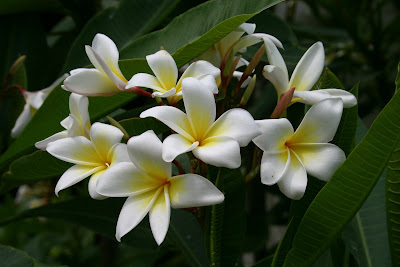
Frangipani, Plumeria obtusa, has got to be the most fragrant plant in my garden.


Bottlebrush, Calistimon rigidus, is blooming for the second time this spring.

Angels Trumpets come out to play when it gets dark.


Louisiana Iris will bloom for months and months and months. Its a great pass-along plant.


Bougainvillea - another tropical that blooms and blooms and blooms!


This is a new Bleeding Heart, Clerodendrum Thomasoniae - I just love the contrast of the white and red.

and the vine pictured below was also labeled as a Bleeding Heart -


Oleander - a real tough cookie - but take care - its leaves are very toxic.


Coral Vine, Antigonon leptopus
An easy way to harvest seed from this vigorous growing vine is to place a sheet on the ground under the vine. In a day or two, gather seeds from the sheet.


Firecracker Bush

Tuesday, April 1, 2008

A Tropical Treasure

A South American native, Bougainvillea puts on quite a show for months on end. I have always loved the many colors of this particular specimen. The dark salmon bracts fade to pale pink as they age. After much looking, I can't decide which variety I think it is . My best two guesses are Bougainvillea Buttiana 'Temple Fire' or Bougainvillea 'Rosenka'. If I had to choose the most descriptive name, it would definitely be 'Temple Fire'.

When I purchased this particular plant it was viney and trained to a small trellis. In the past five years, I have come to see that it's natural form is actually bushy and smallish (small for a bougainvillea, that is).
Bougainvillea is propogated by stem cuttings taken in the winter or spring. It blooms on new growth so feel free to trim away after a flush of blooms. Hardy to 25 degrees, bougainvillea is a great choice in Deep South Texas.

Friday, March 14, 2008

Beautiful Bougainvillea

I'm going to be away from a computer for this month's Garden Bloggers Bloom Day - so I thought I would make an early post with just one bloomin' thing. This sprawling woody vine puts on a colorful show whereever it grows! Discovered in the late 18th century,Bougainvillea is a South American native. It has small white tubular flowers, surrounded by 3 large paper-like bracts. Much like the poinsettia, its bracts are the showy part of a bougainvillea. There is even a variety with double blooms (or bracts) - that one tends to be more compact and, as a bonus, has no thorns! Bougainvillea flourishes in zones 9 - 11. I always thought that hot weather made it bloom more - but a grower told me that it is the short days of winter that spur the bloom. Bougainvillea doesn't like wet feet so be sure to plant her in well drained soil. Although she prefers a nice loamy soil (don't we all!), she adapts pretty well to heavier clays. Disease-wise, there isn't much that bothers bougainvillea. Occasionally, I will go out to find something munching on mine, but within a few days new leaves have filled in the bare spots. This one seems to take care of herself~