Showing posts with label butterfly plants. Show all posts

Friday, October 16, 2015

Monarch Migration - Feeding Them Along the Way

I saw a few small groups of monarchs flitting around the yard today so I'm thinking that this is the beginning of their migration south.   They were really loving the mistflowers today.   But here are some more nectar plants that butterflies seem to go for in my garden.


One of today's monarch visitors feeding on the blue mistflowers.    This mistflower grows low to the ground, dies back in the winter, and blooms in the spring and the fall.  


 Caelsalpenia or Mexican Royal Poinciana with what this uneducated butterfly watcher thinks is some sort of skipper.    Grow it for the blooms and the butterflies are just a bonus.   It has long legume looking seed pods and reseeds easily.   Expect die-back in all but the mildest winters. 


Lantana in all colors is magnetic to butterflies.   The open shape of the flower gives them easy access to the flowers nectar.  I was told that the orange lantana doesn't make nectar, but I've seen butterflies feeding on them so . . .    well, you decide for yourself.   


Lantana comes in tons of different colors.  This pink and yellow combo is a native that you will find growing in brushlines and that we find growing in our tree fields.   Isn't it a beauty!  


Turk's Cap is loved by butterflies and hummingbirds both.    It blooms on new growth so don't be afraid to trim it to the size  you want.   But be aware that it is a vigorous volunteer - but it's easy to pull out when it pops up where you don't want it.   I love large sweeps of Turk's Cap
This delicate little groundcover is called frogfruit.  There is a second variety which has a seraded leaf.    Butterflies love this stuff!   It's a perennial so expect it to die back in the winter.
 
 
This Tropical Milkweed has been the subject of lots of controversy.   With the decline of the monarch population the past few years, some have suggested that tropical milkweed is to blame and that we should only plant the native varieties.  There is a disease that old Tropical Milkweed develops that is toxic to Monarchs.  After a bit more research, it seems that we can keep growing the tropical variety but we are supposed to trim it  back in the fall.  Have no fear;  it will grow back the following spring.  Another thing to consider is that you don't want your migrating butterflies to become confused by available host plants and think they should stay and lay eggs.   Cutting your host plants back in the fall keeps them moving south after a short stop for re-fueling.   


And last, is Porterweed.   It's a vigorous grower with dark purple blooms that must be delicious because mine always has butterflies hanging around. 

Saturday, May 24, 2014

Black Swallowtails

This is a female black swallowtail butterfly.  The mail is a bit more colorful. Unfortunately, this one was lyng dead on our back sidewalk.  We hope that she managed to lay some eggs before she bit the dust. 

With the exception of queens or monarchs, I really no one butterfly i'm another.   That's one of my goals – to be able to identify all the creatures that hang out in our yarden.  

A few weeks ago, we happened upon a few black swallowtail caterpillars feeding on the parsley.  
To my untrained eye, they look like pretty young caterpillars.  If you want to attract black swallowtails to your yard, plant dill, fennel, parsley, and carrots.    These are  "host foods" for black swallowtails - meaning, it is what the caterpillars need to eat when they hatch.   
If you are unsure of the identification of a bug, catch one.  Put it in a jar so that you can see it top and bottom.  Take a picture if that would help.   There are some great bug id websites out there.  I go to bugguide.net  You can search for yourself or you can submit photos for experts to reply with an id.  I don't know how I found info pre-internet!

Friday, December 27, 2013

Attracting Wildlife to Your Garden

This morning we visited my sister-in-law at her new home and soon-to-open B&B.   The M-T Nest is going to be geared to birders and naturalists.   In under an hour, we saw cardinals, green jays, banded kiskadees, a Harris hawk and, of course, Texas' state bird, mockingbirds.   She told tales of the hunting habits of their resident barn owls.    And that was just on our drive up the drive and from inside the house.   It kinda reminded me of Chevy Chase's movie, Animal Farm.  Remember it?   They're trying to sell their New England country home and have enlisted all the townsfolk to help   When the prospective buyers approach the house, someone releases deer to scamper across the law - what a pastoral scene - well, unless you have first-hand experience with deer in your yard

Anyhow, it got me thinking about what our landscapes need to include if we want to attract wildlife to our little piece of paradise.   Some good general guidelines are the requirements to certify a yard as a Certified Backyard Wildlife Habitat.   It's a Texas Parks and Wildlife program.   You can find the application here 
   
Basically, you need food sources, water sources, cover from preditors, and nesting sites.  I had assumed that I'd have to have an almost completely native landscape but the certification only requires that at 50% of the planting a be native.    

Sometimes you will want to get more specific.   We've planted a pecan tree to appeal to the local parrots and leave our sabal and Washingtonia palms untrimmed so the orioles a nice nesting place.  We've left a gnarly old Ashe tree with lots of trunk rot for the Eastern screech owls   We plant fennel, dill, and parsley for the caterpillars to munch on.   And we have lots of red blooming plants to appeal to the hummingbirds.     Frogs find refuge in overturned clay pots and we definitely want some frogs around.  They are voracious mosquito eaters.   

In this new year, I challenge you to plant with a purpose.  Do a little research before you go to your local garden center.   Choose items both for their beauty and for what they will draw into your garden.  Happy gardening! 


Friday, October 23, 2009

Mexican Mint Marigold

Mexican Mint Marigold, Tagetes lucida, is quite the hardy herb.  Growing in heavy clay and receiving sporatic irrigations, this yellow flowering perennial catches your eye.  Planted as a 4" pot two years ago, it survived a 6 month construction project and a few winters.  This spot has such poor soil that we have reverted to using potted plants.  I love how it fills the area.   An equally hardy Lemongrass is growing behind the Mexican Mint Marigold.  Also known as Mexican Tarragon or Winter Tarragon, Tagetes lucida can be substituted for French Tarragon.   Personally, I think it has a stronger flavor so I use it sparingly.   Use it in soups or chicken dishes.   Mexican Mint Marigold blooms in the summer and fall - attracting lots of butterflies.  

If you are in the market for some herbs, drop by the Master Gardeners booth at the Rio Grande Valley Birding Festival.    The trade show is located at the Casa de Amistad in Harlingen, Texas and runs from November 12 -15

Thursday, May 21, 2009

Shade Garden Updates

Although the bright morning sun has washed out the detail of the these white 'Candidum' Caladiums, in person they are stunning. As a bonus, they were planted last spring and have graced us with a second year of beauty. I think this little vignette has all the layers needed for interest. The trees overhead aren't visible in this shot but their canopy offers a nice "frame" for the scene. The shrubs, Firebush, Hamelia patens, are a serene backdrop for the statuary and annual plantings in the tiny circular bed. Around the time the caladiums melt in our summer heat, the Firebush grab the attention with their red and orange blooms. They love, love, love our heat!


I am excited to see that all the Yaupon Hollies, Ilex vomitoria, have bloomed heavily this spring. Planted in 2005, they are yet to produce one single red berry! Yaupon Hollies are dioecious, which means some bloom with male flowers and some bloom with female flowers. In other words, you need a male and a female in order to get berries. However, these were labeled 'Pride of Houston', which are supposed to be self-pollinating. One nurseryman, Al, suggested that I plant more Yaupons (I already have 5) - of any variety. So just upwind of these, there is now a border of 7 or 9 Dwarf Yaupons.

In the meantime, I am checking the plants for berries- and have found a few very tiny green ones where the flowers were. I'm holding my breath, but I have hope for red berries at Christmas time!

This is my "Lasagna Garden Bed" one year later. Even though it is the middle of the "Shade Garden", there is ample afternoon sun to grow a healthy crop of Cosmos. The bed is bordered with Dusty Miller, Senecio cenerario, which was planted last August. A couple of the plants didnt' survive the winter and their replacements haven't filled back in yet. Plus, I trimmed them all back by about 1/2 in April. Don't you love their silver color? Such a nice contrast to everything else. The everything else (whether you can see it or not) includes Cat's Whiskers, Orthosiphon aristatussome, some fat-fronded Ferns, and Coleus. All the hummingbirds are hanging out on this side of the house this year. I haven't come up with a plan for this area yet - so these free and nearly free items are serving me well.

Wednesday, February 18, 2009

Better Late Than Never - GBBD February 09 Edition

A few butterflies have been attracted to the red blooms of the Kalanchoe, Kalanchoe blossfeldiana. This member of the Sedum family blooms from January through late spring.


It looks like the Bougainvillea are going to be show-stoppers this year. Although we've decided to trim and train this one up onto the roof, I can't bear to begin the process until after the flowers are fading. Blaze, a climbing rose, has begun blooming. One of these years, I'm going to learn how and when to prune this baby.


Spicy Jatropha buds - Buds today, blooms tomorrow . . .


Spineless Cactus


We once had a prickly pear cactus - beautiful blooms, but oh, how treacherous to work around!

A close-up of its red and yellow blooms is below.


Surely hummingbirds will arrive soon to feast on the bottlebrush! It must be awfully sweet stuff.


This Mealycup Sage, Salvia farinacea 'Victoria Blue' , has especially vibranty blossoms right now - sometimes later blooms seem to be paler in color.


Trailing white lantana is exploding with blossoms. I love the contrast of the white flower next to the dark green leaf.


Look at how delicate and perfect each individual flower is!


But I don't know who I'm trying to kid - because in reality, this thistle is what is REALLY blooming in my garden right now! My Book Club met at my home last night - how embarrassed was I when one of my friends told me I should remove that weed near the front door . . . . Just look at all the seeds . . . . I'll really have a problem next year if I don't get out there - and quickly!
To see more of what is blooming in gardens around the world, visit Carol at May Dreams Gardens.

Friday, October 17, 2008

Butterflies & Blooms

Took a little stroll in Ramsey Park the other day and if I didnt' know better, I would have thought it was Spring! Everything was in bloom - and the butterflies were this - Sulfers, Queens and many like the picture below. I think this butterfly is a Bordered Patch, Chlosyne lacinia. According to the National Audubon Society Field Guide to North American Butterflies, it is the most widespread and abundant "checkerspot" of the Americas. Its range is SE California east to Texas and south to Argentina. Habitat is subtropical thorn forests, desert hills, weedy edges of agricultural fields, river bottomlands, pinyon pine and oak woodlands, parks and gardens - in other words, just about everywhere there are plants!

I can usually find any Valley native plant I'm looking for in Trees, Shrubs, & Cacti of South Texas, by Everitt & Drawe - the not this pretty white flower. I'm a huge fan of white flowers - they don't photgraph worth a darn, but they sure are beautiful at dawn and dusk. The RGV Master Naturalists always have a booth at the RGV Birding Festival. They are certain to know this plant!
And of course, there was lots of Turks's Cap. The Turk's Cap, Malvaviscus arboreus var. Drummondii, inspired me so that we went straight to Grimsell's to pick up a few pots for my garden. I can't decide whether I was blown away by the number of blooms or the number of butterflies!

Saturday, October 4, 2008

Think Spring

Although this Texas Bluebonnet, Lupinus texensis, may scream springtime, it's time to start thinking wildflowers! If you want to grow Bluebonnets from seed, they need to be in the ground in October or November. I like to scarify my seed first! Line a coffee can with rough sandpaper and put your seed into it. I leave my can in the kitchen and every time I pass it, it gets a few shakes. After a week of shaking, they're ready to go in the ground.

Wednesday, July 30, 2008

Here Kitty, Kitty


How great is this plant that I want to write about after only having it for 10 days! Cat's Whiskers, Orthosiphon stamineus is a tender perennial shrub that grows to about 3' x 3'. The info on its plant tag promised a home run - filtered sun (my new bed is in a filtered sun, pushing shadey spot), attracts hummers and butterflies and a good cut flower. I knew I had to give it a try - and planted a 4" pot in the shade garden 5 days before Hurricane Dolly. I'm afraid ya'll are gonna get pretty be sick of me referencing Hurricane Dolly, but deal with it . . . . Two days after the storm, as we were beginning to gather up the broken tree limbs, this little gal was already blooming! With everything around her looking so crummy, this little Cat's Whiskers brings a smile to my face!

It really does look like Cat's Whiskers! Orthosiphon stamineus can also be found with light blue or a lavender blooms. My only fear is that Dave's Garden says it needs to stay consistently moist. We'll see how adaptable it is . . . .

Friday, July 4, 2008

God Bless America

Wishing everyone a very happy 4th of July! We woke up to a Fall-like morning and a little rain shower (which was a little hard to enjoy since we are in the middle of grain harvest on the farm).

Just wanted to share our flags flying proudly in the South Texas breeze. At the base of the flags is my little patriotic bed. It contains red and (barely blooming) white pentas, 'Lady in Red' salvia, and mealycup sage 'Victoria Blue". Last week I added a red porterweed and transplanted a blue one from another bed. It would be perfect if only the white pentas had more flowers - maybe next Fourth . . . . Those of you with good eyes may have noticed the volunteer cosmos plant. She's in a bare spot so I'm letting her stay until she blooms.


Tuesday, June 3, 2008

Try and Try Again

This little vignette has turned a hum-drum area into something that gives me an inordinate amount of pleasure. When we planted this Firebush, Hamelia patens, hedge, we left an "alcove" near the garage for something special. We see this small planting bed every time we leave the house and when we drive back in, when we take out the trash and when we feed the dog - I'll bet I pass it at least 5 or 6 times each day. The last few years, I've tried a number of different plants here - a large potted Crown of Thorn, Euphorbia splendens var. milii , potted vines climbing an iron trellis, a white potted Bougainvillea, a trailing Lantana, Lantana montevidensis, draping down the pillar, and even a chimenea - What possessed me to think we would ever pull our lawn chairs onto the driveway for a bonfire? - I found I didn't drag a hose over here to water a potted plant regularly enough basis to keep the plants healthy - and that led to my non-living focal point. One year I built the small raised annual bed with one row of blocks. That didn't make much of a statement, so the next spring, a second row was added - and that was exactly what was needed. This area has been planted for year-round interest. The firebush is just coming into it's own and will bloom until our first cold snap in October or November. In front of the firebush are red Kalanchoes, Kalanchoe blossfeldiana, which will bloom from December through late spring. The small raised bed hold Caladiums right now but soon they will be melting in our heat and will have to be replaced with something more heat tolerant. It's such a small area that it easy to replant and inexpensive too. This is what I love about gardening - the everchanging (and hopefully, improving) of the garden. Some people can put a plan on paper and have it come out lovely - but for me, it's try and try again. The creation of a lovely vignette or a pleasing plant combination is a process. The joy I receive from this little bed comes as much from the process of its creation as from the end result.

Thursday, May 15, 2008

Garden Bloggers Bloom Day in Paradise

Flowering trees are taking center stage this month

. . . and the most stunning of all is the Royal Poinciana, Delonix regia. This deciduous tree is related to Mimosa. It begins blooming with a large flush and can continue for a number of months. The seed pods will be 1 - 2 feet in length.
This Jacaranda, Jacaranda mimosifolia, is growing at the Texas Tourist Bureau in Harlingen. It towers over the building flashing its iridescent purple blooms.

The blue flowers are really coming into their own right now.This was the first time I've planted Salvia 'Victoria Blue'. I'll definitely be looking for it again next spring.


This is Eupatoriam 'Padre Island'. I can't keep all the Eupatoriums straight - this one crawls along the ground and is very salt tolerant.

and finally, blue Porter Weed.


Pato de Chiva

One branch of my Yucca or Spanish Dagger, Yucca treculeana, waited until May to bloom.

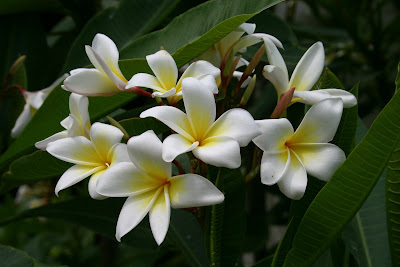
Frangipani, Plumeria obtusa, has got to be the most fragrant plant in my garden.


Bottlebrush, Calistimon rigidus, is blooming for the second time this spring.

Angels Trumpets come out to play when it gets dark.


Louisiana Iris will bloom for months and months and months. Its a great pass-along plant.


Bougainvillea - another tropical that blooms and blooms and blooms!


This is a new Bleeding Heart, Clerodendrum Thomasoniae - I just love the contrast of the white and red.

and the vine pictured below was also labeled as a Bleeding Heart -


Oleander - a real tough cookie - but take care - its leaves are very toxic.


Coral Vine, Antigonon leptopus
An easy way to harvest seed from this vigorous growing vine is to place a sheet on the ground under the vine. In a day or two, gather seeds from the sheet.


Firecracker Bush