
The aphids are coming!
The aphids are coming!
I'm afraid that this warning is a bit late for this stand of Hamelia patens or Firebush. About a half of the individual plants are already affected to one degree or another. One is already completely defoliated and the others are all a flitter with insect activity. 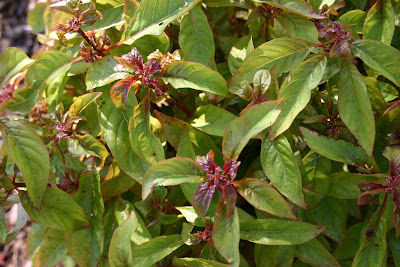 Notice the shine from the honeydew on this plant - Add the cupping of the new growth and you can be pretty certain you have a healthy community of aphids.
 Notice the shine from the honeydew on this plant - Add the cupping of the new growth and you can be pretty certain you have a healthy community of aphids.
On a side note, I want to share with you the first aphid treatment I ever read about (and this was my practice for years!). Treatment consisted of a Q-tip and rubbing alcohol. It works well, but it would take hours of time and gallons of rubbing alcohol for this infestation. Of course, this treatment was described in a book about houseplants. . . .
 Pictured above is one of the Hamelia paten (Firebush) that has not been affected yet. I was a little unconvinced when my husband suggested that we just leave this planting alone and let nature take its course. He even opined that this could be good as it would attract lots of beneficials to our yard. Although he has farmed for over 30 years, I wasn't convinced and did a bit of research on my own. In his article, Aphids in Texas Landscapes, Bastiaan M. Drees from Texas A & M concurs.
 There are many different kinds of aphids and most entomologists will tell you that identifying your pest exactly is not important. Notice the yellow aphids on this firebush. If you look closely you can see some white skins. Aphids molt about 4 times on their journey from larvae to adult stage.

 Check out the spreading wings on this ladybug. She must be ready to fly off to a new - and more bountiful - plant. A ladybug egg hatches somewhere between 4 and 10 days. But the "baby" is not exactly a miniature of the adult.
 The above bug is a ladybug larvae, often refered to as an alligator. The close-up picture below depicts just how descriptive the name "alligator" is.
 The presence of alligators is a good sign that we are well on the way to controlling our aphid infestation. It means that we have multiple generations of beneficials in our garden.
  This alligator is so much duller than the others. I wonder if it is molting. It has the same markings as the vibrantly colored one above. The Ladybug Lady shares larvae and adult pictures that show various ladybug species.
 My husband pointed out this white fuzzy beneficial. He couldn't give me a name for it but assured me this is a good guy! Looking at this plant might make you think you need to take some action. But look a bit closer. Most of the markings are molted skins. To treat at this point would kill your garden beneficials.

 Pictured above is one of the Hamelia paten (Firebush) that has not been affected yet. I was a little unconvinced when my husband suggested that we just leave this planting alone and let nature take its course. He even opined that this could be good as it would attract lots of beneficials to our yard. Although he has farmed for over 30 years, I wasn't convinced and did a bit of research on my own. In his article, Aphids in Texas Landscapes, Bastiaan M. Drees from Texas A & M concurs.
 There are many different kinds of aphids and most entomologists will tell you that identifying your pest exactly is not important. Notice the yellow aphids on this firebush. If you look closely you can see some white skins. Aphids molt about 4 times on their journey from larvae to adult stage.
To further prove his point, my hubby took me outside to check for beneficials. This orange ladybug was the first we saw. She was moving so fast that I had a hard time getting a good picture. I guess when you have this number of aphids to devour you have no time to waste!
There are about 500 different Ladybug species in the United States and almost 5,000 worldwide! They come in a variety of colors (Reds, yellows, orange, gray, black, brown and even pink) with and without dots.
Check out the spreading wings on this ladybug. She must be ready to fly off to a new - and more bountiful - plant. A ladybug egg hatches somewhere between 4 and 10 days. But the "baby" is not exactly a miniature of the adult. The above bug is a ladybug larvae, often refered to as an alligator. The close-up picture below depicts just how descriptive the name "alligator" is.
 The presence of alligators is a good sign that we are well on the way to controlling our aphid infestation. It means that we have multiple generations of beneficials in our garden.
  This alligator is so much duller than the others. I wonder if it is molting. It has the same markings as the vibrantly colored one above. The Ladybug Lady shares larvae and adult pictures that show various ladybug species.
 My husband pointed out this white fuzzy beneficial. He couldn't give me a name for it but assured me this is a good guy! Looking at this plant might make you think you need to take some action. But look a bit closer. Most of the markings are molted skins. To treat at this point would kill your garden beneficials.
Could this bug have been inspiration for the set designer of The Matrix? Up close, he does look pretty vicious!
Happy gardening from my little biology lab to yours!

